
RCM Services Reimagined:
EHR Optimization, Staffing, Analytics
Most behavioral health organizations don’t have a billing problem. They have a workflow, system, and accountability problem. Revenue is lost quietly through misconfigured payer settings, outdated fee schedules, and EHR capabilities left underutilized, creating gaps that gradually compound.
Our Revenue Cycle Practice was built to address this directly. Working inside behavioral health organizations across multiple platforms and service lines, we see consistently how configuration challenges, misaligned workflows, and gaps between clinical and billing data create revenue cycle problems that are hard to trace and harder to fix without the right cross-system expertise.
Fix the Systems Driving Your Revenue Cycle, Not Just the Symptoms.
The Hidden Cost of Revenue Cycle Problems
WHY THIS IS HARD
Revenue cycle problems in behavioral health do not always reveal their source. By the time leaders notice something is wrong, missed billing, denial patterns, and cash flow gaps have often been building for months. The root causes are almost never what they appear to be on the surface.
EHR capabilities often go underutilized
Most organizations have invested in an EHR that can do far more than it is currently doing. When configuration is incomplete and front-end processes aren't aligned, gaps at intake, eligibility, and authorization show up as denials weeks later. By then, the original problem is hard to trace.
Processes are not written to best practice standard
Without clear, standardized processes, aligned to best practices, across every function that touches revenue, staff make individual decisions that create inconsistent outcomes. The billing team ends up absorbing problems that started long before a claim was ever created.
Billing staff turnover can create lag and lost revenue
Replacing a billing staff member costs an estimated 50 to 100 percent of their annual salary when you account for lost productivity, retraining, and revenue lag. But turnover is rarely the root cause. It is usually a symptom of systems and processes that make the work harder than it needs to be.
EHR configuration and support rarely align with billing operations
Most organizations have IT support for infrastructure and a billing team for claims. Very few have someone whose role is to sit at the intersection of both and make sure the system is configured to support the revenue cycle end to end.
Revenue Cycle Assessment
EVERY ENGAGEMENT STARTS WITH ROOT CAUSE CLARITY
Cynthia Sikina, Principal Consultant, Finance & Revenue Cycle Operations, leads Continuity's Revenue Cycle Assessment practice. She brings decades of hands-on financial leadership across healthcare settings, including roles as Chief Financial Officer for physician groups and a 100-bed cancer center, as well as interim CFO for large nonprofit behavioral health agencies. She has completed revenue cycle assessments for behavioral health organizations across the country, delivering findings that are actionable and grounded in how organizations actually operate. Her financial acumen extends well beyond billing. She understands organizational structure, payer dynamics, EHR configuration, and the relationship between systems and revenue cycle performance, and that breadth is what allows her to identify root causes that others miss.
Whether you are looking to understand where revenue is at risk, prepare your organization for full revenue cycle management, or simply take a critical look at a process that has not been examined in years, a Revenue Cycle Assessment gives you the clarity to move forward with confidence.
Some organizations complete an Assessment as a standalone service and use the findings to make improvements with their existing team. For organizations moving toward full Revenue Cycle Management, the Assessment is a required first step. It establishes the baseline we need to take over operations effectively and minimizes surprises following execution of assessment recommendations.
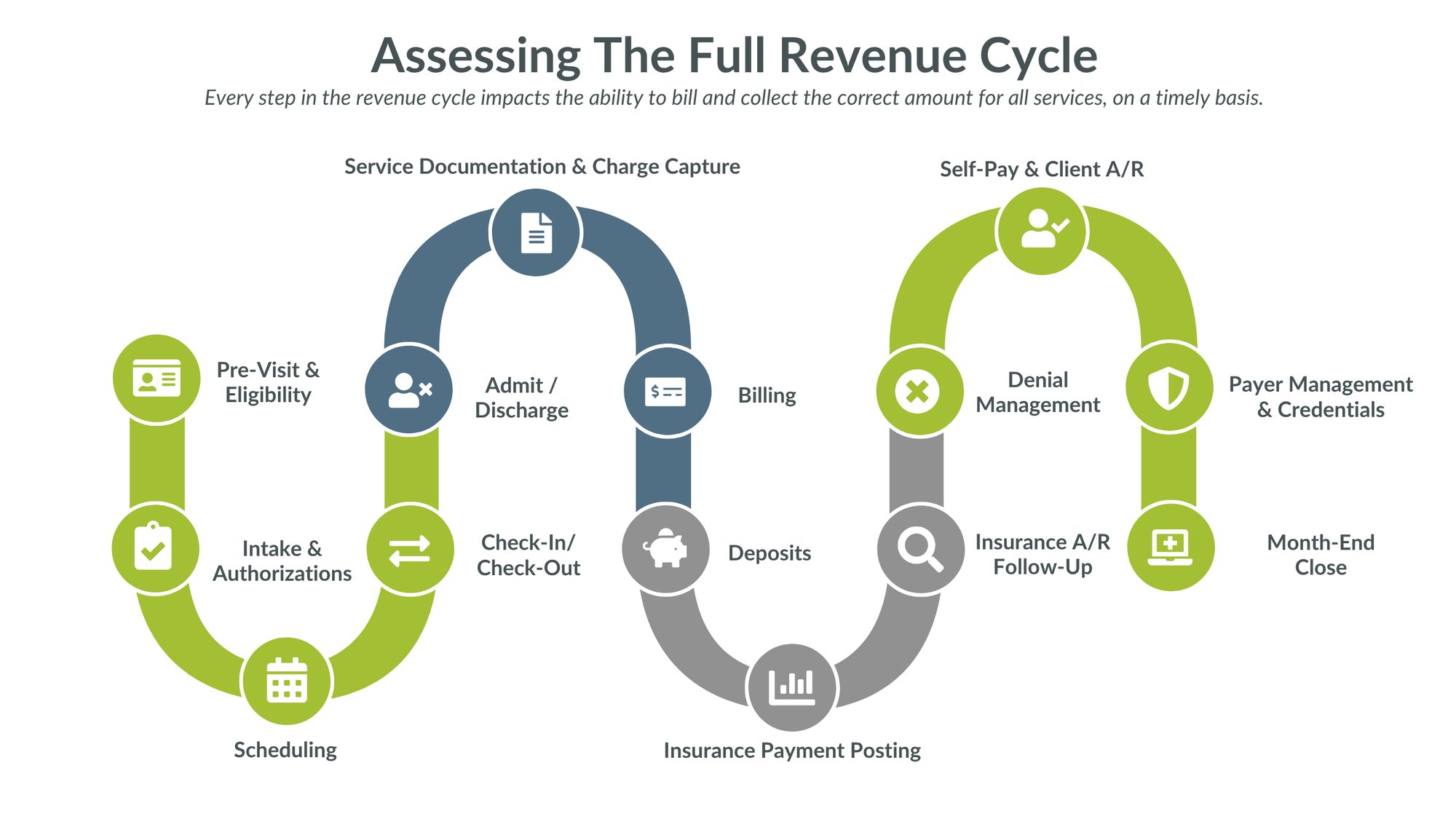
What We Analyze
-
End-to-end workflows from intake through final reconciliation
-
EHR configuration, clearinghouse and financial system integration
-
A/R performance, denial trends, and charge lag
- Policies, procedures, staffing levels, and organizational structure
What You Receive
-
Comprehensive findings report with prioritized recommendations
-
Revenue Cycle Recommendations Grid
-
Baseline KPI metrics including charge lag, denial rate, days in A/R, and net collection rate
- Executive presentation of findings and risks
Revenue Cycle Management
MORE THAN BILLING. A CONTINUOUS OPERATING MODEL
A managed model that takes responsibility for how your entire revenue cycle performs, not just who processes the claims.
Once an Assessment is complete and key recommendations are addressed, we transition into ongoing Revenue Cycle Management. This is not only outsourced billing. We take ownership of the systems, workflows, and standard operating procedures that drive revenue cycle performance, and we provide the billing execution to support it.
Because regulations change, payer requirements shift, and rates are updated, Revenue Cycle Management is not a one-time fix. It is a continuous operating model built to adapt, optimize, and perform over time.
Disciplined Billing Execution
Claims generation, submission, reconciliation, and A/R follow-up handled by a team that understands your systems and payer requirements. We help ensure claims go out clean and revenue comes back on time.
Denial and A/R Management
Root cause analysis across technical, clinical, and documentation issues. Appeals management and workflow fixes that prevent the same denials from recurring so your team stops fighting the same battles.
Workflow and SOP Control
Standardized, optimized processes across every function that touches revenue, not just the billing team. We align what happens at intake, in clinical documentation, and in authorization management with what needs to happen for clean claims to go out the door.
EHR and System Optimization
Configuration and maintenance to ensure compliance, accuracy, and speed to reimbursement. We help ensure your EHR is set up to support the revenue cycle, not work against it, and keep it current as requirements change.
Performance Management
We actively manage revenue cycle performance through KPI ownership, weekly operating reviews, and role-based accountability. Each function is measured against clear targets, with continuous oversight to identify issues, drive resolution, and improve results over time.
Reporting & Executive Visibility
We deliver real-time visibility into your revenue cycle through operational dashboards, weekly performance insights, and executive-level reporting. Leadership has clear, actionable data to understand performance, identify trends, and make informed decisions.
What You Can Expect
When revenue cycle performance is managed holistically, and not the billing level alone, organizations experience fewer surprises, stronger cash flow, and greater confidence in their financial data. With Continuity Consulting, you can expect:
- Fewer denials and faster reimbursement
- Clearer visibility into where revenue is being lost and why
- EHR configuration and department standard operating procedures built around compliance, accuracy, and best practice standards
- Financial data that leadership can act on
- Revenue protected at every step, not only at the billing stage

Built for Behavioral Health
Revenue cycle challenges in behavioral health are almost always configuration and process problems before they are billing problems. Our Assessment surfaces what is being missed and why. The right ongoing management model helps ensure it remains optimized.
Continuity connects revenue cycle performance directly to how your EHR is configured, how your processes are built, and how your staff are supported. We don't only process claims. We partner with your organization to help ensure everyone is doing their part so you can bill and collect the correct amount for all services provided, on a timely basis.